You use your putter on almost every hole, often two or three times. Picking the right one makes a real difference to your score, and it’s one of the easiest clubs to buy used, because putters barely wear out.
The first decision is the head shape: mallet or blade. Here’s how to choose.
The two shapes
Blade putters have a narrow, slim head, a bit like a small iron laid flat. The classic version, often called an “Anser” or “Newport” style after famous early designs, has a flat face with small extensions at the heel and toe. The Ping Anser and Scotty Cameron Newport 2 are well-known examples.
Mallet putters have a larger head that extends further back from the face. They come in many shapes, from small half-moons to big, wing-shaped heads. The Odyssey White Hot OG #7 and the TaylorMade Spider Tour are popular mallets.
| Blade | Mallet | |
|---|---|---|
| Head size | Small and slim | Larger, extends back |
| Forgiveness on off-center hits | Less | More |
| Alignment help | Usually a single line or dot | Often long lines or shapes |
| Best for | Arcing strokes, good feel | Straighter strokes, steadiness |
| Look | Classic, traditional | Modern, sometimes bulky |
Forgiveness: why mallets help most newer golfers
When you hit a putt off the center of the face, the head twists, and the ball comes off slower and slightly offline. A mallet spreads its weight out toward the back and edges, so it twists less. Golfers call this higher MOI (moment of inertia), which simply means resistance to twisting.
In practice that means a mallet keeps mishit putts closer to the right speed and line. That’s why many newer golfers find mallets easier, especially on short putts where nerves creep in.
Blades are less forgiving, but many golfers like the feel and feedback they give. You know straight away when you’ve hit it off-center.
Match the putter to your stroke
Your putting stroke matters as much as your skill level. Make a few practice strokes and watch the putter head.
- Straight back and straight through: the face stays square to the target throughout. This suits a face-balanced putter, which is common in mallets.
- Slight or strong arc: the head swings inside on the backstroke, then back to square and inside again on the follow-through, like a gentle door swing. This suits a putter with toe hang, common in blades.
To check a putter’s balance, rest the shaft across your finger and let the head hang. If the face points straight up at the sky, it’s face-balanced. If the toe (the far end of the head) points down toward the ground, it has toe hang. The more it hangs, the more it suits an arcing stroke.
This isn’t a strict rule. Some mallets have toe hang and some blades are face-balanced. But it’s a good starting point.
Alignment aids
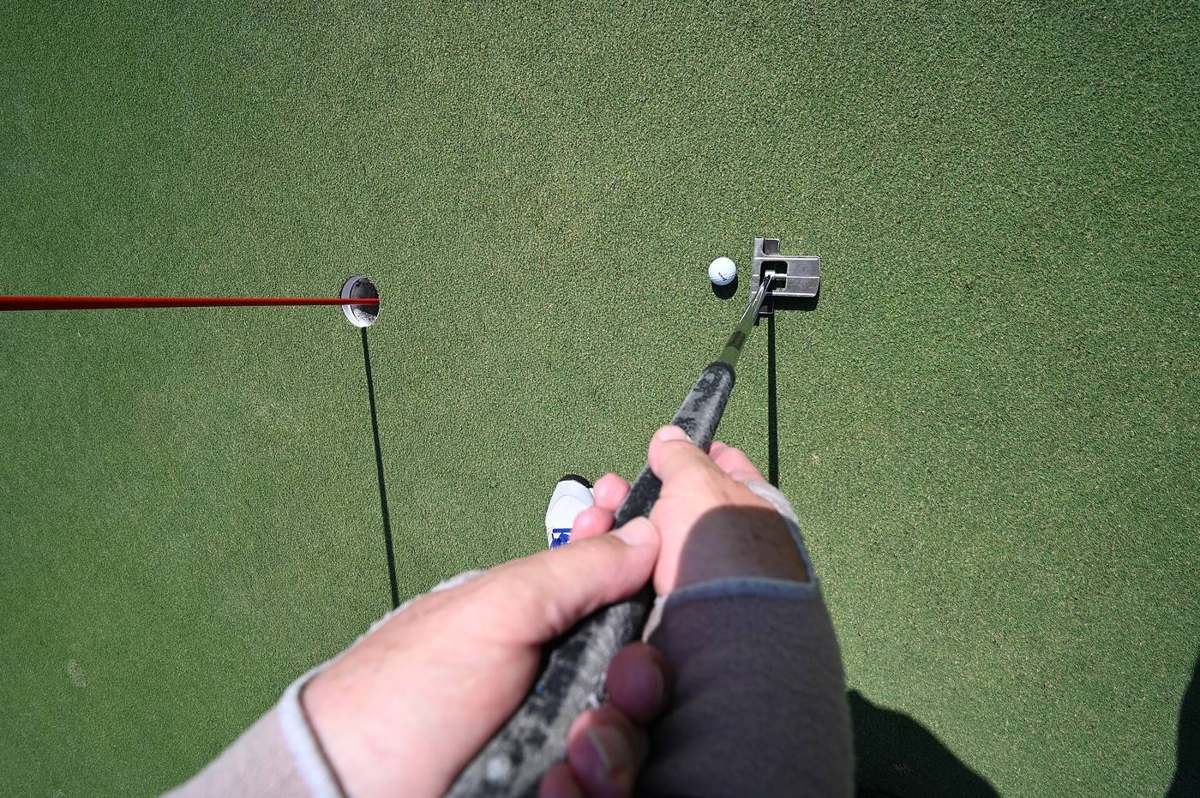
Many putts are missed because the face was aimed wrong before the stroke even started. Putters help with aim in a few ways:
- Sight lines: one or more lines on top of the head pointing at the target. Mallets have room for longer lines.
- Shapes and contrast: some mallets use white and black, or a pattern of balls or bars, to help your eye square the face. The Odyssey “#7” and “2-Ball” designs are examples.
- Simple dots or short lines: common on blades, with less visual help.
Try lining up a few putts at home with different styles. Some golfers aim better with long lines, others find them distracting. Pick whichever makes it easiest for you to point the face at the hole.
Length matters more than brand
Most putters come in 33, 34 or 35 inches. The right length lets you stand comfortably with your eyes over or just inside the ball and your arms hanging naturally.
As a rough guide:
| Your height | Typical putter length |
|---|---|
| Under 5’4” | About 33” |
| 5’4” to 5’8” | 33” to 34” |
| 5’9” to 6’0” | About 34” |
| 6’1” to 6’3” | About 35” |
| 6’4” and taller | 35” to 36” |
Posture and arm length matter too, so treat this as a starting point. A putter that’s too long makes you stand too upright with bent elbows. Too short and you’ll hunch over. A club shop can shorten a putter for a small fee.
Which one should you choose?
- Newer golfers: start with a mallet. It’s steadier, easier to aim, and more forgiving on short putts.
- Arcing stroke and like a classic look: try a blade with some toe hang.
- Straight stroke: a face-balanced mallet usually fits best.
- Not sure: a mid-size mallet or a “wide blade” sits in between, giving some forgiveness with a slimmer look.
Above all, choose the putter you feel confident standing over. Confidence counts for a lot on the green.
Buying a used putter
Putters don’t take full swings, so they wear very little. That makes them one of the best buys on the used market. Check these before you buy:
- Length. Make sure it’s listed and fits you, or budget for a shop to adjust it.
- Face. Light marks are fine. Deep dings on the face, or a damaged face insert, can affect roll.
- Shaft. It should be straight, with no bends or rust.
- Grip. Many used putters need a new grip. Putter grips come in many sizes, and a larger grip can quiet down overactive hands. See when to replace golf grips.
- Head cover. Nice to have, but don’t pay much extra for one.
Prices vary a lot by brand and condition. As a rough guide, many good used putters sell for about $50 to $150, while premium brands like Scotty Cameron often cost much more. For most golfers, a well-known mallet from a few seasons ago is excellent value. Our condition grades guide explains the grading terms you’ll see.
Pick your putter with the rest of your bag
Used Golf Club Finder asks your height to suggest a putter length, and lets you choose mallet or blade, then picks a used putter alongside the rest of your clubs.
The short version
- Mallets are more forgiving and easier to aim, so they suit most newer golfers.
- Blades suit golfers with an arcing stroke who want feel and a classic look.
- Straight stroke: face-balanced. Arcing stroke: some toe hang.
- Get the length right first, usually 33 to 35 inches.
- Putters barely wear out, so a used one is often the best value in the bag.