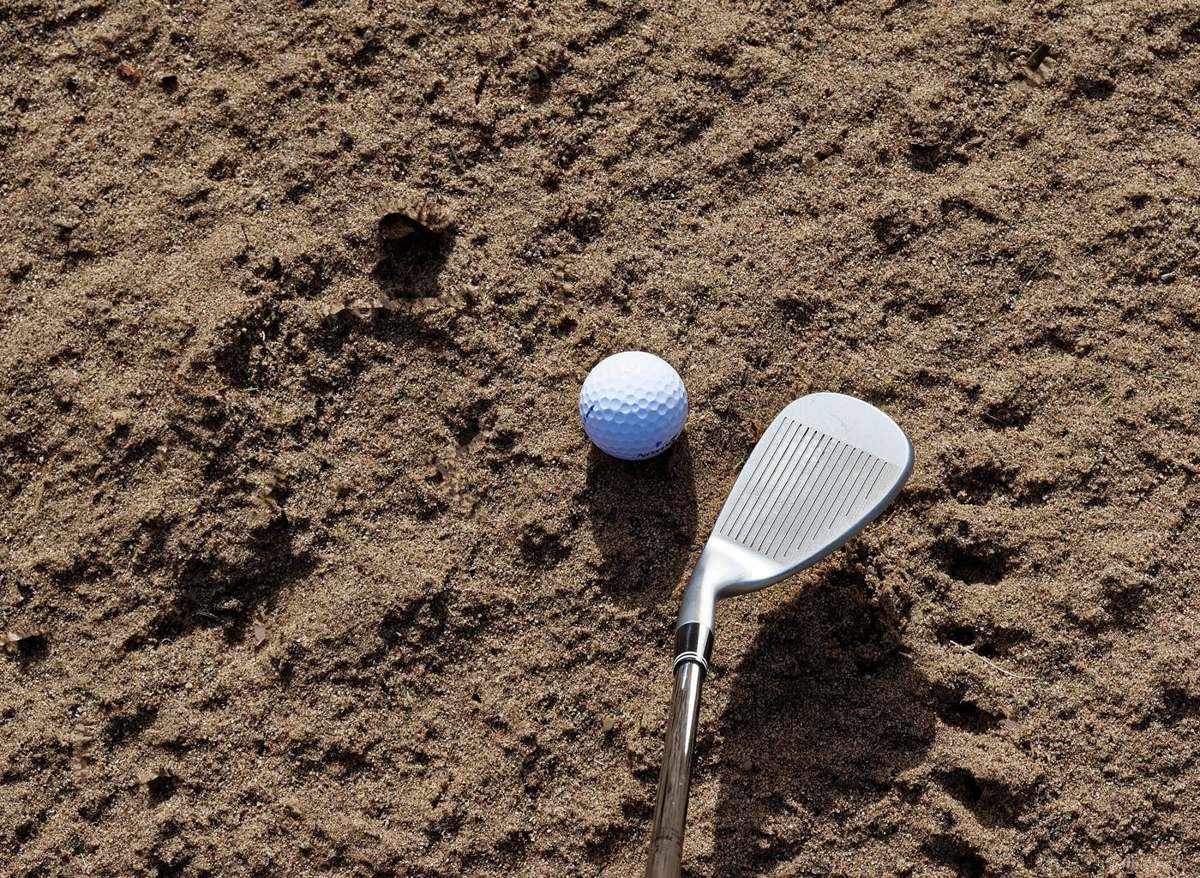
Wedges are the clubs you use for short shots: pitches, chips, bunker shots and full swings from about 120 yards and in. A lot of strokes are saved or lost with them, and they’re also where it’s easiest to end up with too many clubs or the wrong ones.
The short answer: most beginners need two or three wedges, and most improving golfers do best with three or four. Here’s how to work out which.
The four types of wedge
Wedges are named by what they’re for, but what really matters is loft, the angle of the face. More loft sends the ball higher and shorter.
| Wedge | Typical loft | What it’s for |
|---|---|---|
| Pitching wedge (PW) | 43° to 47° | Full shots and longer chips. Comes with most iron sets |
| Gap wedge (GW, sometimes AW or UW) | 48° to 52° | Fills the distance gap between PW and sand wedge |
| Sand wedge (SW) | 54° to 56° | Bunkers, short pitches and chips |
| Lob wedge (LW) | 58° to 62° | High, soft shots over obstacles and to tight pins |
Pitching wedge lofts vary a lot between iron sets. Many modern game improvement sets have strong lofts, with a PW around 43° to 45°. Older or players sets are often 46° to 48°. Check yours before you buy anything else, because it decides everything below it.
Spacing your lofts
The goal is even distance gaps between your wedges. A good rule of thumb is 4° to 6° of loft between each wedge. Each step of about 4° is very roughly a 10 to 15 yard difference on a full swing, though that varies with swing speed.
Example setups:
| Your PW loft | Two wedges | Three wedges |
|---|---|---|
| 43° to 44° | Not ideal: the gaps get too big | 48°, 54°, 58° (or four: 48°, 52°, 56°, 60°) |
| 45° to 46° | 50° and 56° | 50°, 54°, 58° |
| 47° to 48° | 52° and 56° or 58° | 52°, 56°, 60° |
If your PW is strong (around 44°) and your next club is a 56° sand wedge, that’s a 12° gap. You’ll have a full-swing distance where no club fits, so a gap wedge becomes important. See how far should I hit each club? for typical distances.
Bounce: the part beginners overlook
Bounce is the angle on the bottom of the wedge between the leading edge (the front) and the lowest point of the sole. It decides how the club behaves when it meets sand or turf.
- High bounce (about 12° and up) skims through sand and soft turf instead of digging. It’s the most forgiving choice for most golfers, especially in bunkers.
- Mid bounce (about 8° to 12°) works in most conditions and suits many players.
- Low bounce (under about 8°) suits firm turf, tight lies and golfers who can open the face and hit delicate shots.
If you’re newer to the game, play in soft conditions, or take deep divots (steep swing), lean toward mid to high bounce, especially on your sand wedge. Many manufacturers stamp the bounce number next to the loft, like “56-12”.
Grind is how the sole has been shaped to let the club sit well when you open the face. It matters more to better players. Beginners can ignore it and choose a standard grind.
When two wedges are enough
Two wedges (your PW plus one more, or a gap and sand wedge alongside the PW) work well if:
- You’re just starting out. One sand wedge for bunkers and chips covers most needs. Learning one club well beats owning four you don’t trust.
- Your PW loft is weaker (46° to 48°), so the jump to a 54° to 56° sand wedge isn’t huge.
- You’re on a tight budget and would rather spend on a forgiving driver or hybrids.
Most beginners should carry a PW, a gap wedge and a sand wedge. The lob wedge is the first wedge to leave out. It’s useful, but its high loft makes it easy to slide right under the ball or skull it across the green.
When three or four make sense
Add a third or fourth wedge if:
- Your PW is strong (43° to 45°) and you need a gap wedge to fill the hole.
- You often face short shots over bunkers or to pins tucked close to the edge of the green, where a lob wedge helps.
- Your contact is consistent enough that you can control distance with each wedge.
To make room, many golfers drop a long iron or a 3-wood. You’re allowed up to 14 clubs total.
Forgiving vs tour wedges
There are two broad styles of wedge:
- Cavity-back wedges have a hollowed-out back like a game improvement iron. They’re more forgiving on mishits and usually come with wider soles and more bounce. A good example is the Cleveland CBX 4 ZipCore.
- Blade-style tour wedges have a solid back and more grind options. They give better players more control around the green, but punish mishits more.
For beginners and higher handicaps, cavity-back wedges are the easier choice. Our guide to game improvement vs players clubs explains the same trade-off across the bag.
Buying used wedges
Wedges wear faster than other clubs. The grooves, the lines on the face, wear down after lots of shots, especially from sand. Worn grooves mean less spin, so the ball runs out further after it lands.
When buying used:
- Check the grooves. They should be clearly defined, with crisp edges. Smooth, shiny spots in the middle of the face mean heavy use.
- Check the loft and bounce stamped on the club, so it fits your spacing.
- Light rust is fine on raw (unplated) wedges, which are designed to rust. Deep pitting on the face is not.
For a beginner, slightly worn grooves aren’t a big deal, and they make the wedge cheaper. Better players who rely on spin should look for wedges in better condition. Prices vary, but used wedges commonly run about $40 to $100 each, and less for older models. Our condition grades guide explains what each grade means.
Get your wedges spaced for you
Used Golf Club Finder looks at the loft of your pitching wedge, then picks wedges that fill the gaps below it and checks every gap in your bag.
The short version
- Most beginners need two or three wedges: PW, gap wedge and sand wedge. The lob wedge is optional.
- Space wedges 4° to 6° apart, starting from your pitching wedge loft.
- A strong PW (around 44°) almost always needs a gap wedge.
- Choose mid to high bounce if you’re newer or play soft courses.
- On used wedges, check the grooves before you buy.